Lexember Monday (Day 14) Music

[personal profile] chanter_greenie asked about music!

In keeping with the idea of god-words (from alder, earlier today), we look at the Tabersi (Proto-Bitrano) god/dess Alivetta/Alibetto.

This deity, one of a collection of dual-natured or dual-gendered gods in the old Tabersi pantheon, inspired the arts. Alivetta/Alibetto began as the overseer of all arts, but by the time of the Gods Purge had long since been relegated only to music, and often only to instrumental music.

Alittao is the art of instrumental music in Bitrani; in Calenyena, this becomes Litvaano, music (as played), and Libbaano, music as sung.

♪ ♪ ♪ ♫ ♪ ♪ ♫ ♪ ♪ ♪ ♫ ♪ ♪ ♫ ♪ ♪ ♪ ♫ ♪ ♪ ♫ ♪ ♪ ♪ ♫ ♪ ♪ ♫ ♪ ♪ ♪ ♫ ♪ ♪ ♫ ♪ ♪ ♪ ♫ ♪ ♪ ♪ ♫ ♪ ♪ ♪ ♫ ♪

This entry was originally posted at http://aldersprig.dreamwidth.org/1026406.html. You can comment here or there.

Lexember Yesterday (15), Books on the Shelf

[personal profile] inventrix asked for books, which got handled a while back:

turnie, noun, book
turniete, 2 books
turniebe, a shelf of books
turnine, some books

So I figured I’d handle shelf and library!

Library, first, is a book-place, Turnietan. This originally referred to any depository of books. Now, a bookseller is a Liezturnie, Seller, of book and a library is a Turnietapon, a book place, scholarly.

And in the library there are shelves!

A shelf is a birtun, from a word which originally meant ledge; a bookshelf is a birtunturnie.

A collective plural of shelves is usually considered a bookcase, unit of shelves. If you collectivize that, birtunbebe, you end up with a slang word for a large gathering of shelves, a storeroom.

This entry was originally posted at http://aldersprig.dreamwidth.org/1026167.html. You can comment here or there.

Lexember Day 16: the Thorn Alder

Today’s word is thorn alder, because I can!

In further proving that my Reiassani persona is a Bitrani transplant to Calenta (tall, light-skinned, short hair, prefers less bright color combinations), the alders, including the thorn alders, exist on Reiassan almost entirely in the borderlands between South and North.

Starting with the taxonomic classification: Although I haven’t determined what the Reiassani version of Kingdom-Phylum-Class-Order-Family-Genus-Species is, but I know that they use {Arran/West-Coast} for such things.

The Alder belongs to the family of spear-leaf trees, adavijamin, where adavi is “spear-blade” and “jamin” is “leaf”. In that family, they belong to the mainer sub-family, “mainer” meaning “grove” or “family group, tribe.”

The Alders themselves keep the name of a goddess otherwise forgotten in the God Purge: the goddess is Talaezia; alders are Taazaa in the everyday speech.

The thorn alder grows shorter and bushier than many alder trees, and a thorn-alder grove is not a fun place to spend a lot of time. Their thorns are long, sharp, and while not poisonous, their pricks can get infected very quickly and easily.

And a thorn in Calenyen is linie, from the Bitrani linnia, making my Calenyena name Lin Taazaalinie.

This entry was originally posted at http://aldersprig.dreamwidth.org/1025828.html. You can comment here or there.

My Aesthetic is… vooooom swissh?

Well, looking through my mental wish list, my pinterest “clothes” file, and the stuff I have on my to-sew…

Sort of like, um. Prairie waif? Goth-with-colors? Knit amish hippy?

layers of tissue-thin shirts, often with too-big necklines and def. with sleeves over my hands, down to my hips, over skirts that are fitted or fittedish to the knees and then SWISH out in a pile of petticoats.

If I had Meentik unutu (and huamu) that is what I would look like every day. Except the days I wore those shirts or loose shirts that go swish over jeans.

Yeah, my mental images never include shoes, either. Too bad I live in the frozen north.

This entry was originally posted at http://aldersprig.dreamwidth.org/1024954.html. You can comment here or there.

Lexember Day 13: Grain

kelkyag asked for Agriculture words — domesticated plants and their fruits. I got a brief start on that!

Food! Always important.

We already have belenuza, potato-parsnip (or earth-apple) and Lok, meal.

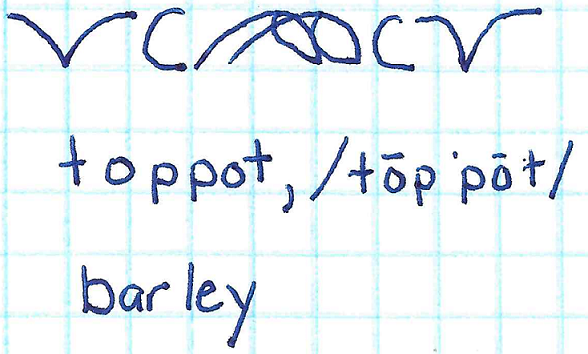
The first grain found by and eventually cultivated by the proto-Calenyena was barley: toppot, /tōp ‘pōt/ a word whose origins are lost in time. Later came wheat, tuz, /təz/ originally toppot-tuz. Tuz is a word that meant pale and can still be found in the word datuz, meaning “an unhappy surprise;” a pale-making.

Rice was borrowed from the proto-Arrans, the west-coast people, along with the name, corbin –> korbin

The long-grained black rice-like grain that was found on Reiassan was called Reiassannon’s Rice, voRiesa korbin.

And if you’ve noticed I slid in a possessive, you’d be correct.

This entry was originally posted at http://aldersprig.dreamwidth.org/1024393.html. You can comment here or there.

Lexember Day 12: Braids

Rix_Scaedu asked for braids. Woo-eee!

Braids are a really important part of Calenyena life and culture. What began as a simple method of keeping hair out of one’s face and off one’s neck became a complex and ever-evolving status and fashion symbol.

I’ve already got the words:

tezyu – goat-hair

lanut – braid

And lanutez – goat-hair braid: someone who is pretending to be something they’re not, a poser.


Braids can be pluralized, of course: Lanutte, lanutne, lanutbe. A collective of braids is a “head” of braids, generally at least six.

See here for images of words.

Calenyen braids vary: rarely does someone, male or female, wear a single braid in their hair, although men will sometimes braid one long braid in their beard.

However, paired braids, done in either a dutch or french style (See this post if the terms are foreign to you), are quite common. They speak of no-nonsense simplicity most of the time and are the hair equivalent of blue jeans today.


Lanut, by itself, refers to a 3-strand french style braid of hair, goat hair, or other hair on an animal. A braid of anything else is a langaip, both from the original lannun, plait, no longer in use.

Braids on the human head are almost always pluralized: lanutne if speaking in general, lanutbe for a full ‘do, lanutte for a two-plait arrangement.

Kalan is to make braids; kalanut is to plait someone’s hair while kalangaip is to plait other things.

A braid that is not french-style is called a hanging braid, lanut-pyik. A braid that is dutch-style is a standing braid, lanut-dob. Braids with more than 3 stands are often called by the number, thus, something like lanut-leen, lanut-dan – four- and five-strand braid.

And, just for one more word, beads for braids are lunlan.

This entry was originally posted at http://aldersprig.dreamwidth.org/1024170.html. You can comment here or there.

My next challenge for the conlang!

http://conlangery.tumblr.com/post/134417557276/hear-your-conlang-introducing-the-show?is_related_post=1

If you’d like to hear your language at the top of the show, translate and record the following sentence in a conlang or natlang:

Welcome to Conlangery, the podcast about constructed languages and the people who create them…
{snip}
*If your conlang belongs to a world that doesn’t have podcasts, you can choose something more culturally appropriate (radio program, show, play, etc.).

/bounce/

This entry was originally posted at http://aldersprig.dreamwidth.org/1023958.html. You can comment here or there.

Discovery – a story introduction for Steam!Reiassan

in the same era as Edally Academy

The messenger was having a hard time making himself understood.

“There’s a strange ship come into the harbor!”

The Emperor’s secretary was not impressed. “What are the shipwrights up to this year?”

“No, not like that. It’s flying strange colors.” The messenger gestured with both hands.

“Pirates?” The secretary frowned. “They’re not supposed to come this far North. They know what’ll happen if they do.”

“Not pirates.

“They’d better not be Bitrani…”

The messenger took a breath and began speaking more slowly, in carefully chosen words. “There is a ship of strange manufacture, flying a flag that is neither piratical or Bitrani and certainly not Calenyena. The people, from what we can see, do not look like us or the Bitrani, and their clothing is strange. There are foreigners coming into the harbor.”

The word foreigner was so old as to be archaic. There was no such thing. There was the empire, and that was it. To the North was ice; to the east was wind. To the south was nothingness; to the west was the great fire rift. There was nothing but the empire; since they had conquered the Bitrani, there were no foreigners to speak of.

Until, it appeared, now. The secretary coughed politely.

“I’ll let His Imperial Majesty know that he needs to see you right now.”

This entry was originally posted at http://aldersprig.dreamwidth.org/1023280.html. You can comment here or there.

A Convoluted Etymology: Lexember Day 11

Rook
/ro͞ok/
noun; plural noun rookte, rookbe, rookne

Family group, tribe.

Collective plural Rookbe is a convocation of all the tribes in an area.

Kozh
/kōzh/
noun; plural noun kozhete, kozhebe, kozhene

When two like things intersect or encounter each other.

-lel
/lel/
adjective

Peaceful.

-gut
/ɡət/
adjective

Violent.

-laizh
/līzh/
adjective

Profitable, with gain

tap
/tap/
verb

To go, in the sense of travel


All right, if you put these words together, you get two sorts of meetings of two tribes: peaceful and violent, kozhrooklel, kozhrookgut.

From kozhrooklel and -laizh we get the idea of trading, a profitable pleasant meeting: kozhrooklellaizh, which over time became kozellaiz, trade.

From Kozellaiz and tap came tapkozhzellaizh, Go to trade, which became tapzellaizh and from that, over a long time, came tappaizh /tap ‘īzh/, from “go to a peaceful, profitable gathering of tribes” to “road”, the thing on which you go to those tribes.

Phew!

See here for images of words.

(And all this because [personal profile] anke wanted words for giving or getting directions…)

This entry was originally posted at http://aldersprig.dreamwidth.org/1023044.html. You can comment here or there.